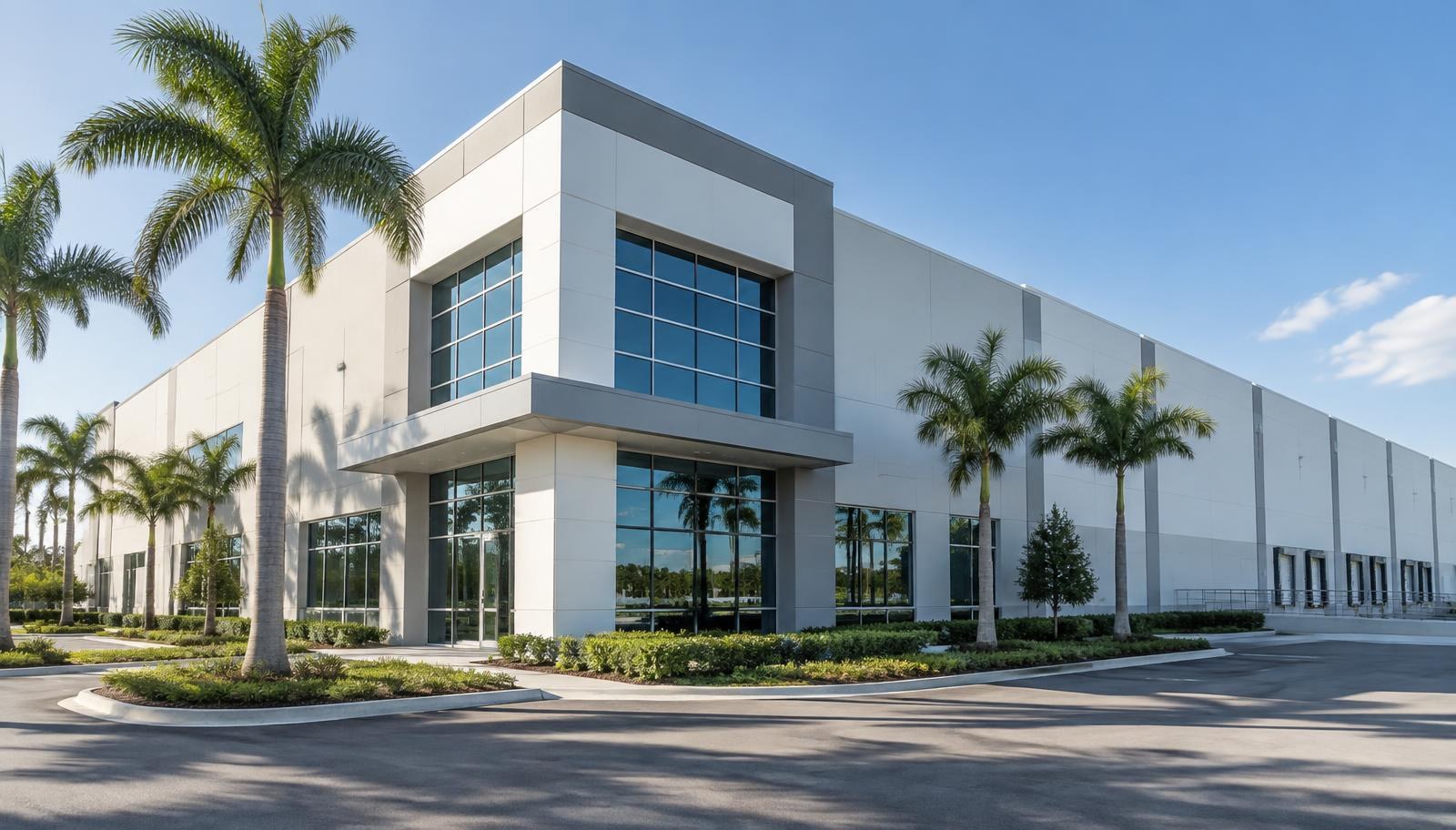
Florida commercial buildings absorb solar heat through exterior walls too. Learn how cool-wall technology works, what Berkeley Lab research says, and how to evaluate a CoolCrete CoolWalls project responsibly.
If you manage a warehouse, office, retail property, school, multifamily building, or industrial facility in Florida, your roof is not the only part of the building exposed to intense solar energy.
Your exterior walls are exposed too.
When sunlight strikes a wall, part of that solar energy is reflected and part is absorbed. The absorbed energy raises the wall's surface temperature. Some of that heat can then move through the building envelope toward the interior.
Cool walls are designed to address that problem by reflecting more solar energy and reducing the amount absorbed by the exterior surface.
For Florida building owners, that can make cool-wall technology worth evaluating—especially when an exterior is already due for repainting or renewal.
But cooler walls, cooler rooms and lower electricity bills are not the same measurement. Understanding that distinction is essential when evaluating any reflective coating.
A cool wall is an exterior wall surface designed to absorb less solar energy than a conventional wall.
Two important properties help describe its radiative performance:
Solar reflectance
Solar reflectance measures the fraction of incoming solar energy that a surface reflects.
It is expressed on a scale from 0 to 1. A higher value means that a greater fraction of incoming sunlight is reflected rather than absorbed.
Thermal emittance
Thermal emittance describes a surface's ability to release absorbed heat through thermal infrared radiation.
It is also expressed on a scale from 0 to 1.
Solar reflectance and thermal emittance are different properties. A building product can therefore perform differently on each measure.
The Cool Roof Rating Council, or CRRC, uses both solar reflectance and thermal emittance in its exterior-wall product rating program.
Florida combines strong solar exposure with a long cooling season.
A sun-exposed wall can absorb solar radiation, become hotter than the surrounding air and transfer some of that heat toward the building interior.
Lawrence Berkeley National Laboratory summarizes the basic physics simply: increasing a wall's solar reflectance lowers its surface temperature in sunlight and reduces daytime heat flow toward occupied space.
That does not mean every reflective wall coating will reduce a building's electricity bill by the same percentage.
Actual building-level effects depend on factors including:
- Wall orientation and solar exposure
- Existing wall color and reflectance
- Wall construction
- Insulation level
- Window area
- Building geometry
- HVAC efficiency and operating schedule
- Internal heat loads
- Shading
- Weather and climate
- The radiative properties of the new exterior finish
This is why a credible cool-wall assessment should evaluate the actual building rather than promise a universal savings percentage.
Berkeley Lab and research partners conducted extensive modeling of cool walls across multiple U.S. climates and building types.
In warm U.S. locations extending from Miami to Albuquerque, researchers reported modeled annual HVAC energy-cost savings of up to approximately:
- 11% for stand-alone retail buildings
- 8.3% for single-family homes
- 4.6% for medium office buildings
These figures require an important qualification.
They are results from Berkeley Lab's cool-wall research scenarios—not measured CoolCrete CoolWalls savings and not a guarantee for any individual building.
A warehouse in Miami, for example, may have different wall construction, HVAC operation, insulation, occupancy and solar exposure than the buildings represented in a research model.
The useful conclusion isn't that every building will save a certain percentage.
It's that independent building-science research shows that wall solar reflectance can affect cooling energy use—and that the size of the opportunity is building-specific.
Commercial facilities can present particularly useful opportunities for cool-wall evaluation.
1. Large wall areas
Warehouses and industrial facilities can have substantial exterior surface area exposed to sunlight.
East-facing walls receive strong morning solar exposure, while west-facing walls can experience intense afternoon exposure. South-facing exposure varies with season and building geometry.
The relevant question is therefore not simply, "How many square feet of walls do I have?"
It is:
Which walls receive meaningful solar exposure, and what happens to those surfaces under real operating conditions?
2. Existing repaint cycles
Most commercial buildings already require periodic exterior maintenance.
That creates an important economic distinction.
If a property needs to be repainted anyway, the decision isn't necessarily between spending nothing and purchasing a cooling technology.
It may instead be between:
- Repainting the building conventionally
- Using the planned maintenance event to add passive-cooling functionality
That incremental-upgrade framework can be more useful when evaluating project economics.
3. Perimeter comfort
Exterior wall temperature can influence heat flow through the envelope, particularly in sun-exposed perimeter zones.
However, a cooler exterior wall does not mean that indoor air temperature will fall by the same number of degrees.
Surface temperature, interior wall temperature, indoor air temperature, heat flow and HVAC energy consumption are different measurements.
A responsible project should keep them separate.
Start with the building rather than the coating.
Step 1: Identify high-solar-exposure walls
Evaluate orientation, shading and wall area.
Large east- and west-facing elevations can be particularly interesting candidates for investigation because of direct solar exposure at different times of day.
Step 2: Document the existing wall
Record:
- Existing color
- Surface condition
- Coating age
- Substrate
- Approximate wall area
- Shading
- Insulation where known
- HVAC conditions
- Areas with comfort complaints
If the building already requires exterior maintenance, document that too.
Step 3: Evaluate the coating's radiative properties
For cool-wall products, solar reflectance and thermal emittance provide more meaningful technical information than simply calling a product "heat reflective."
The CRRC Wall Rating Program provides a standardized framework for independent testing and reporting of these properties.
CRRC says wall-product radiative testing can include ASTM C1549 or ASTM E903 for solar reflectance and ASTM C1371 or its approved slide method for thermal emittance. Rated products also undergo outdoor weathering before aged values are established.
A CRRC listing itself does not mean a product meets a universal definition of "cool." CRRC publishes measured radiative properties so those values can be evaluated against the requirements of applicable codes or programs.
Step 4: Establish a baseline
For a pilot project, measurements should be taken before drawing conclusions.
Useful information can include exterior surface temperatures, interior wall surface temperatures, ambient conditions and comparable untreated or conventionally coated control areas.
Measurements should be made under comparable conditions whenever possible.
A single infrared reading can be useful observational data, but it is not the same as an annual energy analysis.
Step 5: Separate measured results from modeled economics
This distinction is especially important.
A field test might demonstrate a reduction in exterior surface temperature.
A building-energy model might estimate an effect on cooling energy consumption.
An electricity-rate assumption might then translate that modeled energy change into potential financial savings.
Those are three separate steps.
Keeping them separate produces a more credible business case.
CoolCrete CoolWalls is being developed as a Cooling Renewal Coating for compatible exterior surfaces including concrete, stucco, masonry and sound existing coatings.
Its primary purpose is straightforward:
Give Your Building a Cooling Upgrade.
CoolCrete is engineered to reflect sunlight and reduce solar heat absorption while renewing and protecting compatible exterior surfaces.
The concept is particularly relevant when a building owner is approaching a repaint or exterior-maintenance event.
Instead of treating repainting only as cosmetic maintenance, the owner can evaluate whether that same project is an opportunity to add passive-cooling functionality.
CoolCrete's current website appropriately does not promise a universal building energy-savings percentage or a specific service-life extension. Project outcomes depend on building conditions, substrate preparation, application, exposure and other factors.
Independent CoolCrete solar-reflectance and thermal-emittance testing should be used when available to quantify the product's radiative performance.
If your commercial building has large sun-exposed stucco, concrete or masonry walls—or is already approaching its next repaint—evaluate the property before assuming every wall offers the same opportunity.
CoolROI is designed to help organize that assessment and provide an illustrative, research-informed starting point.
Calculate Your Potential Savings with CoolROI.
Modeled estimates are not guaranteed savings or measured performance for an individual property.
Reflective walls are not a substitute for every other energy-efficiency measure.
The U.S. Department of Energy describes the building envelope—including walls, windows, roof and foundation—as the thermal boundary between indoor and outdoor conditions.
Insulation, air sealing, glazing, shading, roofing and HVAC performance can all influence cooling demand.
That means a cool-wall project should be considered as one component of a building strategy.
For some properties, insulation or HVAC improvements may deserve priority.
For others—particularly buildings already scheduled for exterior coating work—the wall finish represents an opportunity because the maintenance expenditure is happening anyway.
Before specifying a product, ask:
- What are its measured solar reflectance and thermal emittance?
- Were those values measured independently?
- Are they initial measurements or aged values?
- Is the product compatible with my existing substrate?
- What surface preparation is required?
- What coverage should I expect?
- What evidence supports durability claims?
- Are energy-savings estimates specific to my building or borrowed from general research?
- Can the supplier conduct a controlled pilot before a large rollout?
- How will results be measured and documented?
Those questions help separate measurable building science from marketing.
Cool walls address a simple physical problem: sunlight hitting an exterior wall can be absorbed and converted to heat.
Increasing solar reflectance can reduce that absorption and lower sunlit wall surface temperature. Independent Berkeley Lab research indicates that this can reduce heat flow into buildings and, under appropriate conditions, reduce cooling energy use.
The actual value for a particular Florida commercial property depends on the building.
That's why the strongest approach isn't to start with a promised savings percentage.
Start with the property. Identify the hottest and most exposed surfaces. Establish the existing maintenance need. Evaluate the coating. Measure what changes. Then determine the economics.
If your building is already approaching a repaint, that creates a particularly useful question:
Why simply repaint a hot exterior when the same maintenance event could become a cooling upgrade?
Have a warehouse, commercial building, multifamily property or industrial facility with sun-exposed exterior walls?
Get a CoolCrete CoolWalls Quote and tell us about your property. We can help determine whether the building is a good candidate for a CoolWalls assessment or pilot.
CoolCrete CoolWalls
Built to Cool. Built to Last.
COOL + RENEW + PROTECT.